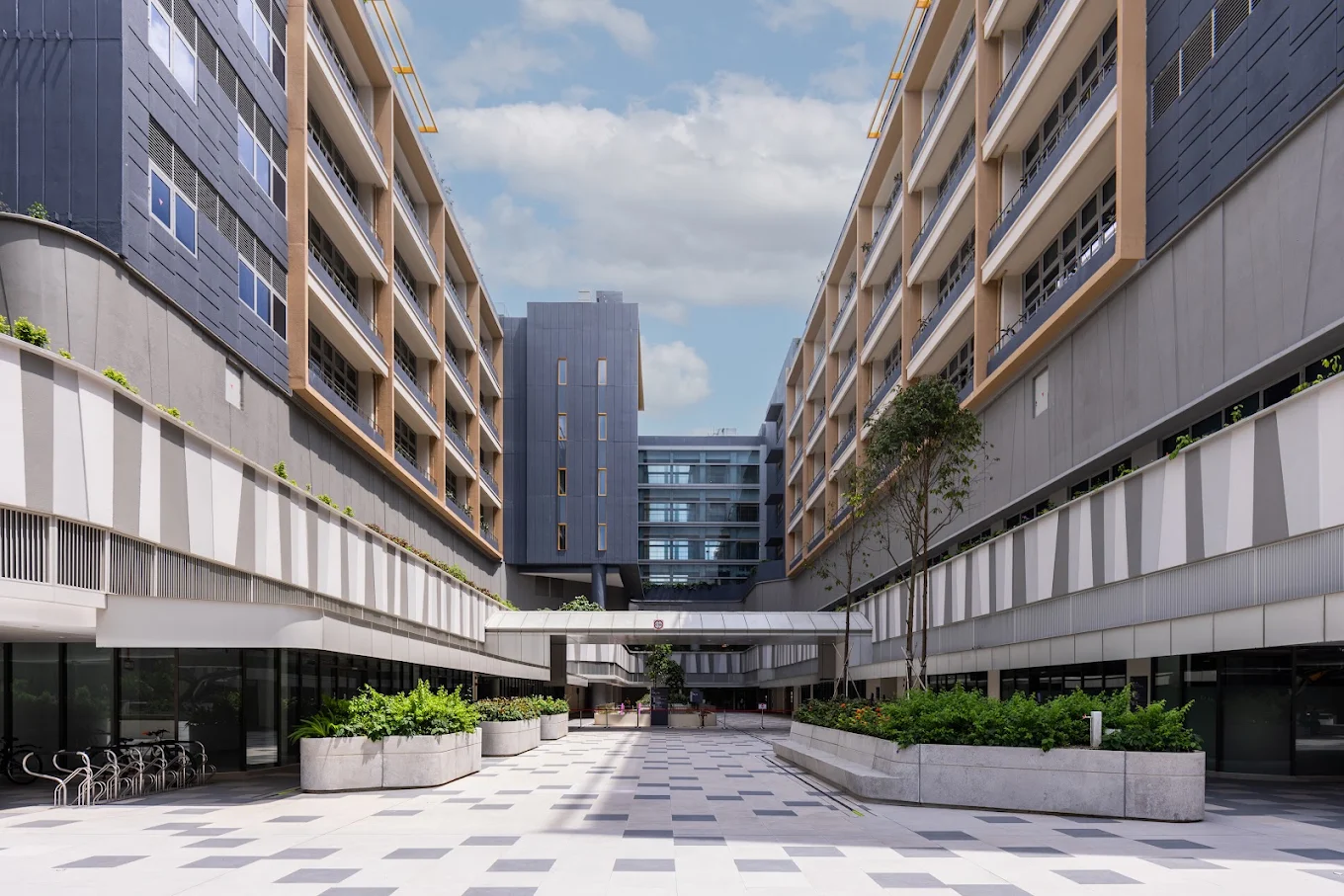
Image source: obtained from publicly available online sources.
PROJECT OVERVIEW
Cost
The project demonstrates how financial investment can be aligned with building performance objectives. Through a lifecycle cost perspective, Woodlands Hospital prioritised solutions that enhance energy efficiency, operational reliability and long-term value rather than focusing solely on upfront costs.
Project Investment
Estimated project development cost
The development of Woodlands Hospital represents an investment of approximately S$1.4 billion, making it one of Singapore's largest healthcare infrastructure projects. The majority of project expenditure was attributed to building construction, healthcare engineering systems and specialised medical facilities required to support a fully integrated acute, community, outpatient and long-term care campus.
M&E systems, including cooling infrastructure, medical gases, power distribution, ICT networks and healthcare engineering services, accounted for a significant proportion of the overall cost due to the intensive operational requirements of a modern hospital. Investment was also directed towards high-performance facades, therapeutic landscapes, smart hospital technologies and sustainability initiatives that support long-term operational efficiency and resilience.
In addition, approximately S$13.4 million was invested in Green Mark-related sustainability features, representing 1.2% of the total construction cost. These measures contribute to projected annual energy and water savings of approximately S$7.6 million, demonstrating the value of lifecycle-based investment decisions.
| Cost Component | Estimated % | Estimated Cost (S$ Million) |
|---|---|---|
| Substructure (Piling, ERSS, Basements) | 15% | 210 |
| Superstructure (Concrete, Structural Steel) | 20% | 280 |
| Architectural Works & Façade | 18% | 252 |
| Mechanical & Electrical Systems | 22% | 308 |
| Medical & Healthcare Infrastructure | 8% | 112 |
| Landscape & External Works | 5% | 70 |
| Smart Hospital & ICT Systems | 4% | 56 |
| Sustainability & Green Features | 1.2% | 13.4 |
| Professional Fees, Testing & Commissioning | 6.8% | 95 |
| Total Construction Cost | 100% | 1,400 |
Estimated allocation based on typical tertiary healthcare developments; actual project cost distribution has not been publicly disclosed.
Operating Expenditure
Estimated Operating Expenditure (OPEX)
Capital cost is a one-off investment, whereas operating expenditure (OPEX) recurs every year for the life of the hospital. Woodlands Hospital's own OPEX breakdown has not been published, so this section uses a large published dataset as an example: the 2018 cost reports of 3,521 private general acute hospitals in the United States, which reported US$732.2 billion in total operating costs (Bai and Zare, 2020).
In that dataset, labour accounted for 41.3% of operating costs, non-capital non-labour items such as supplies, services and utilities for 54.6%, and capital costs for only 4.0%. Building related items (operation of plant, housekeeping, and maintenance and repairs) together made up about 4.4% of operating costs.
Figure 1. Operating cost by type
Share of total operating costs, 2018
Figure 2. Selected cost items
Share of total operating costs, 2018
Relevance to Woodlands Hospital
Plant operation and maintenance are a small share of hospital OPEX, but they recur every year and are directly shaped by design decisions. This is why the projected annual energy and water savings of approximately S$7.6 million from the Green Mark features are significant over the building's life.
Example data from United States hospitals; not Woodlands Hospital figures. Shares in Figure 2 are selected items only; the grey slice shows the remaining share not itemised.
References
Bai, G. and Zare, H. (2020) ‘Hospital cost structure and the implications on cost management during COVID-19’, Journal of General Internal Medicine, 35(9), pp. 2807–2809. doi:10.1007/s11606-020-05996-8. Available at: pmc.ncbi.nlm.nih.gov/articles/PMC7326305