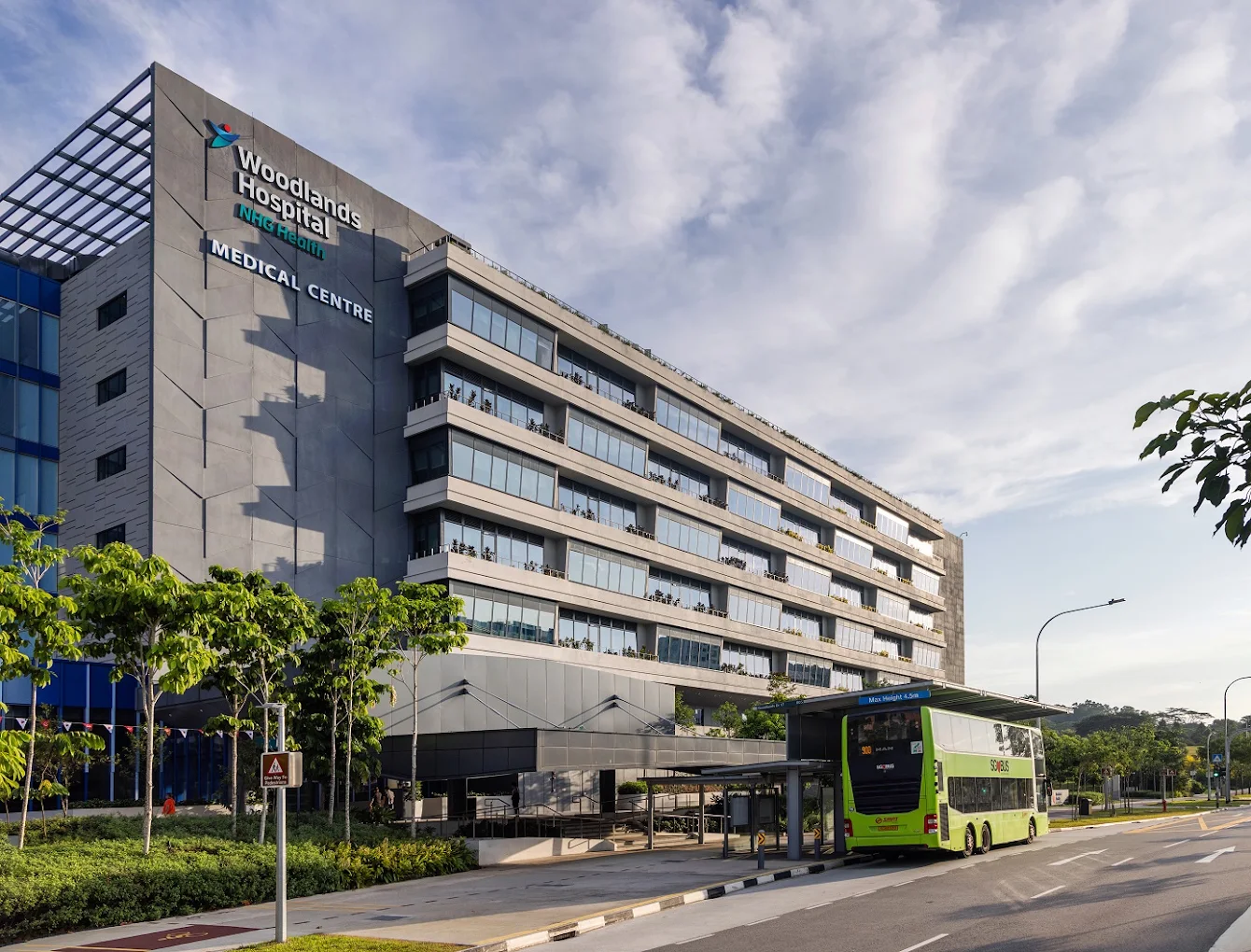
Woodlands Hospital Medical Centre facade with bus stop and landscaped street frontage

Climate analysis

Woodlands Hospital is located in northern Singapore within a hot-humid equatorial climate characterised by high temperatures, high humidity, abundant rainfall and seasonal monsoon winds. The campus planning and building orientation are designed to minimise solar heat gain, enhance natural ventilation, maximise daylight and create a comfortable healing environment through extensive integration of greenery and passive design strategies

Latitude
1.35° N (equatorial climate)
Mean air temperature
27.8 °C annual mean; monthly means 26.8–28.6 °C
Mean relative humidity
82.2 % annual mean
Annual rainfall
2,113.3 mm over about 171 rain days a year
Prevailing winds
Northeast Monsoon (Dec to early Mar) Southwest Monsoon (Jun to Sep)
Solar condition
High solar exposure with strong east and west sun

Monthly temperature in Singapore, 1991–2020

Temperatures stay high and even all year; the daily swing (about 6 to 8 °C) is larger than the difference between months.

22242628303234JanFebMarAprMayJunJulAugSepOctNovDecTemperature (°C)Mean daily maximum, Jan: 30.6Mean daily maximum, Feb: 31.5Mean daily maximum, Mar: 32.2Mean daily maximum, Apr: 32.4Mean daily maximum, May: 32.3Mean daily maximum, Jun: 31.9Mean daily maximum, Jul: 31.4Mean daily maximum, Aug: 31.4Mean daily maximum, Sep: 31.6Mean daily maximum, Oct: 31.8Mean daily maximum, Nov: 31.2Mean daily maximum, Dec: 30.5Monthly mean, Jan: 26.8Monthly mean, Feb: 27.3Monthly mean, Mar: 27.8Monthly mean, Apr: 28.2Monthly mean, May: 28.6Monthly mean, Jun: 28.5Monthly mean, Jul: 28.2Monthly mean, Aug: 28.1Monthly mean, Sep: 28Monthly mean, Oct: 27.9Monthly mean, Nov: 27.2Monthly mean, Dec: 26.8Mean daily minimum, Jan: 24.3Mean daily minimum, Feb: 24.6Mean daily minimum, Mar: 24.9Mean daily minimum, Apr: 25.3Mean daily minimum, May: 25.7Mean daily minimum, Jun: 25.7Mean daily minimum, Jul: 25.4Mean daily minimum, Aug: 25.3Mean daily minimum, Sep: 25.2Mean daily minimum, Oct: 25Mean daily minimum, Nov: 24.6Mean daily minimum, Dec: 24.3
  • Mean daily maximum
  • Monthly mean
  • Mean daily minimum
Climate normals: Meteorological Service Singapore (MSS), Changi Climate Station, 1991–2020. Changi is the national reference station; Woodlands, in the north, may differ slightly. weather.gov.sg

Design connection · Stormwater-Sensitive Design

High Rainfall and Stormwater Resilience

Singapore's abundant year-round rainfall, including periods of intense tropical rainfall, makes stormwater management an important component of site planning. At Woodlands Hospital, landscaped drainage strategies such as bioretention areas and permeable surfaces can therefore be understood not only as landscape features, but also as climate-responsive infrastructure.

The rainfall record is the climatic justification for the campus's bioretention swales, rain gardens, permeable landscaping, site drainage, covered pedestrian routes and wider stormwater management.

Monthly rainfall in Singapore, 1991–2020

Rainfall peaks in the wet phase of the Northeast Monsoon (Nov to Jan); December is about three times as wet as February.

Values in millimetres. Climate normals: Meteorological Service Singapore (MSS), Changi Climate Station, 1991–2020. Changi is the national reference station; Woodlands, in the north, may differ slightly. weather.gov.sg

Design connection · Natural Ventilation & Wind Capture

Humidity & Thermal Comfort

Persistently high humidity increases the importance of air movement, shading and heat-load reduction. Naturally ventilated and transitional areas therefore benefit from layouts that facilitate air movement, while mechanically conditioned hospital spaces require effective environmental control.

Because the outdoor air is already humid, bringing it inside does not by itself make a space comfortable. Natural ventilation works here only together with air movement, shade and lower heat loads, which is why it is used in circulation and transitional areas rather than relied on alone.

Monthly relative humidity in Singapore, 1991–2020

The monthly mean stays between about 81 and 86 %; on a typical day humidity rises above 93 % around dawn and falls to the low 60s in the afternoon.

5060708090100JanFebMarAprMayJunJulAugSepOctNovDecRelative humidity (%)Mean daily maximum, Jan: 94.7Mean daily maximum, Feb: 93.7Mean daily maximum, Mar: 94.5Mean daily maximum, Apr: 95.6Mean daily maximum, May: 95.2Mean daily maximum, Jun: 93.7Mean daily maximum, Jul: 93.3Mean daily maximum, Aug: 93Mean daily maximum, Sep: 93.8Mean daily maximum, Oct: 95.2Mean daily maximum, Nov: 96.5Mean daily maximum, Dec: 96Monthly mean, Jan: 83.5Monthly mean, Feb: 81.2Monthly mean, Mar: 81.7Monthly mean, Apr: 82.6Monthly mean, May: 82.3Monthly mean, Jun: 80.9Monthly mean, Jul: 80.9Monthly mean, Aug: 80.7Monthly mean, Sep: 80.7Monthly mean, Oct: 81.5Monthly mean, Nov: 84.9Monthly mean, Dec: 85.5Mean daily minimum, Jan: 66Mean daily minimum, Feb: 62.1Mean daily minimum, Mar: 61.4Mean daily minimum, Apr: 62.3Mean daily minimum, May: 63.7Mean daily minimum, Jun: 63.4Mean daily minimum, Jul: 64.1Mean daily minimum, Aug: 63.6Mean daily minimum, Sep: 62.2Mean daily minimum, Oct: 61.4Mean daily minimum, Nov: 65.5Mean daily minimum, Dec: 68
  • Mean daily maximum
  • Monthly mean
  • Mean daily minimum
Hour-by-hour humidity normals are not published in the MSS climate normals table, so the daily range is shown by the mean daily maximum and minimum. Climate normals: Meteorological Service Singapore (MSS), Changi Climate Station, 1991–2020. Changi is the national reference station; Woodlands, in the north, may differ slightly. weather.gov.sg

Passive Design Strategies at Woodlands Hospital

Optimised Building Orientation

Ward towers are primarily oriented along the north-south axis to minimise exposure to the low-angle east and west sun. This passive design strategy reduces solar heat gain, lowers cooling demand and improves thermal comfort for patients, visitors, and staff.

Natural Ventilation & Wind Capture

Building blocks are strategically spaced to capture prevailing Northeast and Southwest monsoon winds. Open courtyards, green corridors and naturally ventilated circulation spaces enhance airflow across the campus, improving outdoor comfort and reducing dependence on mechanical ventilation in non-clinical areas.

Daylighting & Glare Control

Courtyards, sky terraces, internal atriums and green fingers introduce abundant natural daylight deep into the buildings. External shading devices, recessed facades and overhangs minimise glare and direct solar penetration, reducing reliance on artificial lighting while maintaining visual comfort.

Landscape-Led Microclimate Cooling

The signature "Park in Campus" concept acts as a passive cooling system. Extensive tree canopies, healing gardens, rooftop greenery and planted terraces provide shading, lower surface temperatures, reduce the urban heat island effect, and create a cooler microclimate across the campus.

Stormwater-Sensitive Design

Bioretention swales, rain gardens, and permeable landscapes manage stormwater naturally by slowing runoff and enhancing infiltration. These passive landscape features improve site resilience while supporting biodiversity and environmental sustainability.

High-Performance Building Envelope

Deep roof overhangs, facade fins, sun-shading elements and thermally efficient envelope systems minimise heat gain and rain penetration. By reducing the cooling load at source, the building envelope improves overall energy performance and long-term durability.

Passive intent to reduce low-angle east/west solar exposure before mechanical cooling
Passive solar response at Woodlands Hospital. Predominantly north-south oriented massing and shorter east-west facing facades reduce exposure to low-angle morning and afternoon sun.

Both analytical diagrams created by Group 5 using AI.

From Climate Conditions to Building Performance

Climate / site conditionPassive design responseExpected effectRelated TBP mandate
Strong solar exposureNorth-south massing, shorter east-west facades and shadingReduces solar heat gainThermal, Energy
Hot, humid conditionsSpaced building blocks with open and semi-open circulationSupports air movementThermal, IAQ
Seasonal monsoon windsCampus porosity and landscaped courtyardsPreserves potential airflow pathsThermal, IAQ
High rainfallRain gardens and green-blue infrastructureManages runoff and sustains landscapeWater, Landscape
High daylight availabilityOrientation, glazing selection and shadingUses daylight while controlling heat and glareVisual, Energy
Road and expressway exposureSetbacks, landscape buffers and functional zoningReduces noise exposureAcoustics

The site strategy therefore forms the first layer of environmental performance: climate-responsive planning reduces environmental loads before active building systems are introduced.